
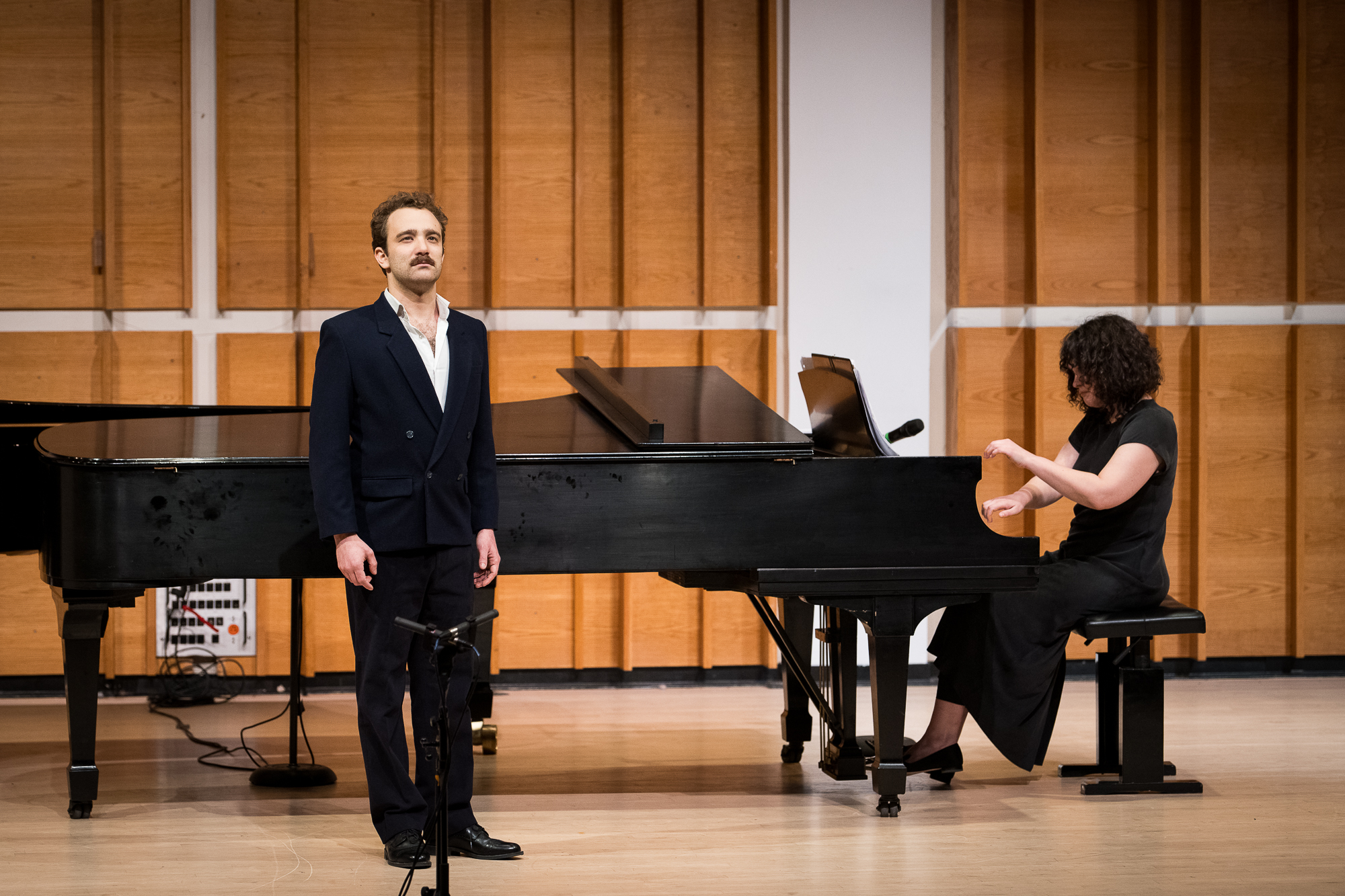

NYFOS has had a history of making schidduch—arranged marriages—between seemingly odd-couple composers. Some years ago, I began the model with a concert of Schubert and Jerome Kern (done out of town, one half devoted to each); in town, we had a rousing success interleaving Dvorak and Harry T. Burleigh, a bolder move; and, more recently, we repeated the experiment with Schubert and the Beatles. When Theo Hoffman first presented that idea to me in 2016, I almost fainted, imagining a chorus of outraged Lieder and rock connoisseurs. But the concert was one of our greatest successes, and our 2025 Schubert/Beatles CD won NYFOS Records, our new record label, its first Grammy nomination. Therefore, when Bénédicte Jourdois floated the idea of a Poulenc-Sondheim program, I was able to accept with sang-froid. Once you’ve paired “An Schwager Kronos” with “Taxman,” the sky’s the limit.
It is true that Sondheim and Poulenc present contrasting virtues. Sondheim’s, of course, are well-known to most American audiences, even if the man on the street may not be aware of their full span. His long career began in the 1950s, when he landed jobs as lyricist for Leonard Bernstein (West Side Story) and Jule Styne (Gypsy). His burning desire, of course, was to write music and lyrics for Broadway shows, but his longtime mentor, Oscar Hammerstein II (lyricist for Richard Rodgers) advised him to get his foot in the door with some of the greatest talents in American theater—not just Bernstein and Styne, but Jerome Robbins, Arthur Laurents, and Ethel Merman.
Clearly, the gamble paid off. Sondheim’s first Broadway show, A Funny Thing Happened on the Way to the Forum, opened in 1962, won multiple Tony Awards, and launched the career Sondheim had dreamed of. Then followed a few dark years: his next show, Anyone Can Whistle, closed after nine performances, and it was followed by another unhappy Broadway experience, a collaboration with Richard Rodgers on a doomed project, Do I Hear a Waltz?. But by the end of the 1960s Sondheim was back on his game, launching a brilliant series of musicals with director Hal Prince—Company, Follies, A Little Night Music, Pacific Overtures, and Sweeney Todd. After the resounding failure of their 1981 show Merrily We Roll Along (their hard work recently vindicated in a stunning new production and movie), Sondheim branched off in a new direction with writer/director James Lapine, using a cooler, more intellectual style in works like Passion, Sunday in the Park With George, and Into the Woods. Still later came Assassins, Road Show, and his valedictory piece, Here We Are, which opened after he died.
Sondheim’s post-1981 work gave him the reputation as an austere genius whose songs are best appreciated by those with an advanced degree in music. And it is true that Sondheim’s gift for melody flowered best in the earlier decades of his long career, while many of the later songs seem to be written in Morse code. But that dismissal fails to acknowledger Sondheim’s gift for creating a staggering variety of musical worlds, from Sweeney’s pungent, Grand Guignol London to Night Music’s elegant, waltzing Sweden. While each show has its unique sound milieu, the ingenious, scrupulous luster of Sondheim’s lyrics is a constant. Every line is polished to a high gloss, without a single awkward phrase or misplaced accent. Who else would rhyme “soul-stirring” with “bolstering”? Who else would come up with the perfect description of a life veering out of control with the lyric, “Then you career from career to career”?
I have come across a few people who don’t know about Sondheim (have they been living under a rock?). But outside of my circle of musician friends and students, I have encountered only a few people who do know about Francis Poulenc. For pianists, singers, opera lovers, chamber music fans, and choral music buffs, he is in the Pantheon. The Met revives their production of his opera The Dialogues of the Carmelites with some frequency, and NYFOS can’t keep its hands off his gorgeous mélodies. But his orchestral works, which would help secure his place in the iconography alongside Ravel and Debussy, are rarely played in New York; the last time the New York Phil programmed his music was 1961.
Poulenc’s life bears both striking similarities and stark contrasts to Sondheim’s. Both were only children, both discovered their passion for music in their childhood, both started piano lessons by the age of eight. Both were gay. But Poulenc had loving parents, while Sondheim’s divorced, leaving him in the care of his mother, a deeply disturbed woman. (When she died, Sondheim refused to attend her funeral.) Each found early idols: Debussy, Schubert, and Stravinsky for Poulenc; Jerome Kern and George S. Kaufman for Sondheim. And each was essentially alone in the world by his late teens: Poulenc because his parents died, Sondheim because his father and mother each abandoned him in their different ways.
Luckily, both men found a parent figure in the form of a mentor: Hammerstein for Sondheim, and the Spanish pianist Ricardo Viñes for Poulenc. The composer credited Viñes with defining his approach not just to the piano but to all of music, rejecting Romantic opulence in favor of something sleeker and sparer. Viñes also premiered Poulenc’s early works and introduced his young student to the cream of Paris’s artistic society.
Poulenc had the good fortune to emerge onto the European classical music scene at the right time. The jazz-age public responded to his bad-boy shenanigans—his début piece was a flashy Rapsodie nègre which both Stravinsky and Ravel admired. And he lived in a culture where a dadaist song cycle, Le bestiare, could still launch a composer’s career. British audiences were the next to succumb to Poulenc’s charms, and soon concert-goers on both sides of the Atlantic were under his spell.
There are composers whose music is instantly recognizable, no matter the genre. You always know when you’re hearing a piece by William Bolcom or Gabriel Fauré, and the same is true of Poulenc. For someone who espoused the clean lines of modernism, much of his music retains an innate sensuality—Debussy’s whole-tone impressionism spirited off to the boudoir. There is also a “tough” Poulenc sound, inspired by Stravinsky and Mussorgsky, that is informed by metallic, industrial rhythms, used for moments of high drama. And then there is Poulenc the boulevardier, tossing off valse-musettes and dipping into the cadences of the music hall. All of it bears his unmistakeable signature. Ned Rorem described Poulenc’s music this way: “At his villa at Noizay, he wrote the greatest vocal music of our century, all of it technically impeccable, and truly vulgar. He was deeply devout and uncontrollably sensual.”
What brings Poulenc, the hedonist, and Sondheim, the egghead, together? Part of it is precisely their sweet-and-sour, tale-of-two-cities contrast. Poulenc, the artistic son of Satie, Chabrier, and Ravel, brings us the very essence of Paris, that unique aioli made of Latin indulgence and Catholic rigor. Most of his music was created for concert halls, with infrequent excursions into the greasepaint world of ballet and opera. Sondheim, on the other hand, is a man of the theater—specifically Broadway musicals. No matter where his musicals are set, he evokes New York—abandoning the heartland-heartbeat of his precursors Rodgers and Hammerstein or Irving Berlin for a sophisticated East Coast sensibility that delights in wordplay, psychological exploration, and ambiguity. If Poulenc sounds like a bistro, Sondheim sounds like a shrink’s office. But whose schedule hasn’t contained both of those consecutive appointments at some point? If you don’t agree, Oil and Vinegar would like a word with you.
Their differences are so obvious that they obscure their similarities. Sondheim’s musical palette includes a healthy dose of fragrant impressionist harmony, particularly in his musicals from the 1970s. This quality is easiest to hear in “Silly People,” a song I have loved for decades but never programmed. In its original setting, the butler Frid attempts to describe that complex mix of post-coital satisfaction and melancholy known as afterglow. It is one of Sondheim’s most openly erotic songs, using soft, jazzy chords filled with augmented intervals to create an atmosphere that teeters between pleasure and pain. My friend George Lee Andrews created the role of Frid on Broadway, and I used to play “Silly People” for him at parties back in 1975. Alas, the song had been relegated to the status of a party piece by Night Music’s opening night: it held up the action in Act II, and Hal Prince decided that no one would be interested in the butler’s complex philosophical disquisition on love. It was obvious to me that Sondheim had actually written an art song, not a theater song, and it has only taken me half a century to bring it to the recital stage where it belongs.
“Silly People” is not the only song that sounds like a distant cousin of Francis Poulenc. I hear some of that Gallic suaveness in “Fear No More,” “Move On,” “Finishing the Hat,” and the theme from Stavisky—a sensuality in the chords indicating that we’re “not in Kansas any more” but somewhere in the banlieue parisienne. And I feel the similarities physically in my hands as I play much of Sondheim’s music, which needs the same soft palm and boneless knuckles I summon up for French song.
I cannot claim that Poulenc’s music evokes America in the same way (although he does quote Stephen Foster’s “Old Folks at Home” in his piano concerto, along with a snatch of Gershwin’s American in Paris). But so much of Poulenc’s harmony—including his habit of adding a jangly, unrelated chord high up on the piano to put an irreverent button on a serious song—comes straight out of American jazz. Ravel, Poulenc’s precursor, had been among the first French musicians to incorporate quintessentially American musical language into his compositions; Poulenc followed in his footsteps. This led to a profound change in the aesthetics of French music, which had hewed to a tradition of stiff academic rigor for decades. As the twentieth century progressed, textures thinned and the public had to revamp its stereotype of French music to the new, jazzy sound of Poulenc, rather than the pompous formality of César Franck.
Most importantly, Poulenc and Sondheim share the ability to write about profound subjects with literacy and a light touch. Sondheim, of course, created his own lyrics, while Poulenc drew on the great poets of his time. But both men were rigorous about setting words to music with grace and clarity. Both were unsentimental, yet both tapped into deep feelings, exposing the complexities of the human heart and the world around us. They are dispensers of startlingly serious amusement.
Tonight’s program is the product of a brainstorming session and that modern convenience, a Google doc where all four of us worked on the program from our various perches. The song pairings had to make sense to at least three of us to make it to the final list, and the sequence went through a few versions before landing on the one you’ll be hearing tonight. We included a few of Sondheim’s showstoppers—“The Ladies Who Lunch” seemed like the perfect companion to Poulenc’s “Chanson à boire.” ”No One Is Alone” was at the top of several performers’ wish-lists, and “Finishing the Hat” was a sine qua non as a partner for Poulenc’s vigorous song about Picasso. Likewise we’ve included some of Poulenc’s iconic tunes—“Hôtel,” “Montparnasse,” and “C’est ainsi que tu es.” But there are plenty of rarities: Sondheim’s theme to the movie Stavisky, which we use as an atmospheric introduction to Poulenc’s wartime song “Le disparu”; both composers’ one-off settings of Shakespeare; the bubble-headed leading lady’s song from Forum (“That’ll Show Him”); an enigmatic Poulenc duet, “Colloque,” that evokes the ambiguous feelings of Sondheim’s couples.
Putting the songs of Poulenc and Sondheim together has been a joy. Poulenc, the essence of Paris (raffish, sensual, contemplative), is the perfect foil for the roiling depth of Sondheim’s New York. They fit together like puzzle pieces, each taking up thoughts and feelings that the other one left off. More than anything, these two superb songwriters shed an indispensable new light on one another.
0 Comments