
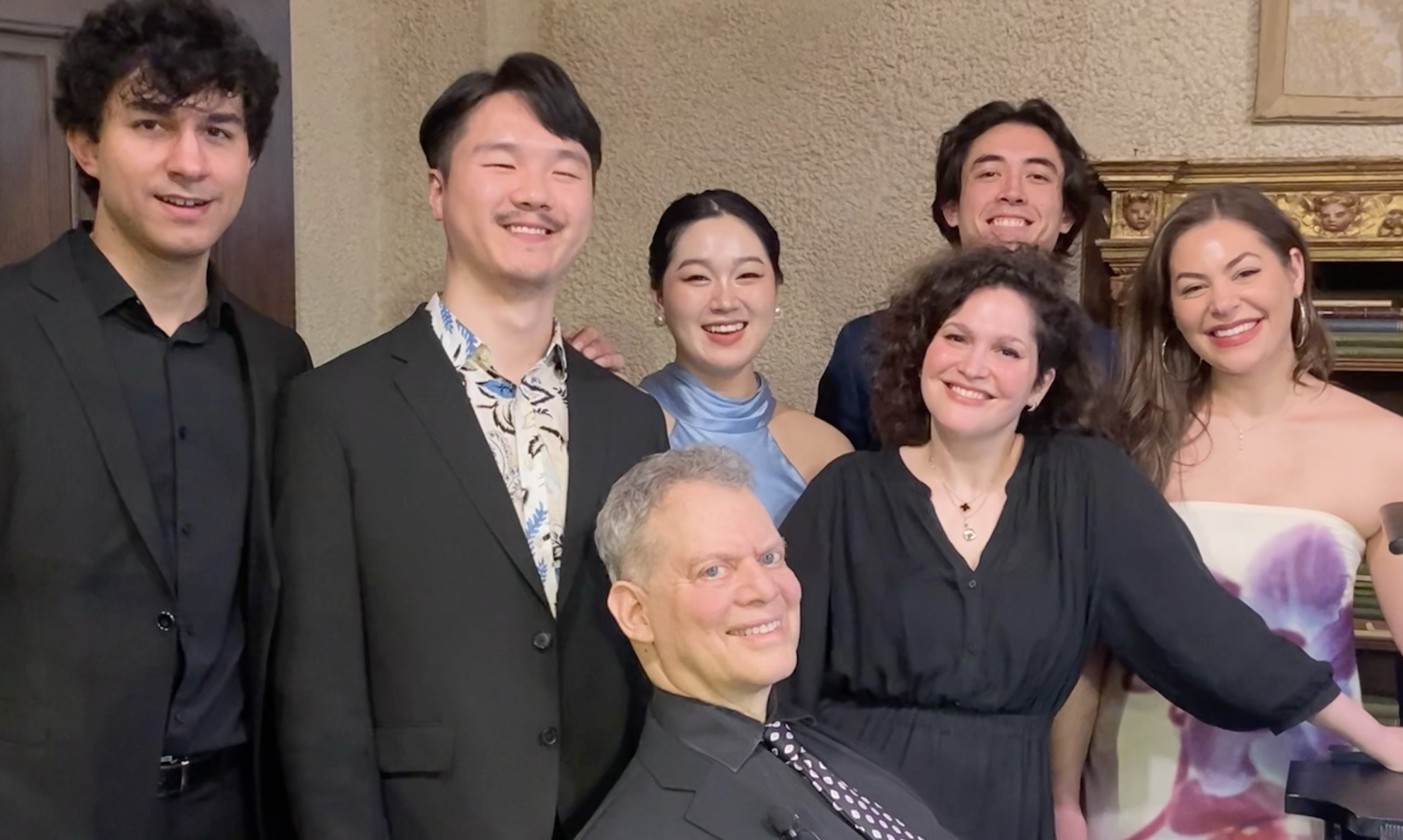

There is a saying in the theater that bad dress rehearsals make for good opening nights. That is kind of an old wives’ tale, but there is a grain of truth in it. I have found that if I have a fantastic day at the piano during dress rehearsal, I will inevitably play worse, sometimes a lot worse, when the public is there. And it’s the same for the cast. Therefore, while I don’t court disaster, I am forgiving about errors, missed notes, flubbed lyrics, smeared portamentos that I swear I banished on Day One, inaccurate transpositions, and all the things that can (and did) invade our Saturday run-through. It was a decent enough rendering of the songs, Shiyu was still a bit careful but clearly on the mend, and it was at least clear that we had a show. Few songs were at their peak of performance, but I was grateful that the cast wasn’t spending precious vocal resources on an empty house. Béné and I gave notes and headed home.
I’m happy to report that the performance went extremely well. It’s always fascinating to see how the Caramoor audience responds to our programs. They certainly like a good, conventional stretto conclusion—the tenor/baritone duet by Rossini, “I marinai,” whipped them up to a few bravos. Musically I think it’s one of the less interesting songs we offered, but the splashy ending worked its traditional magic. Of the slower songs, Reynaldo Hahn’s “La barcheta” might have been the audience favorite, especially when spun out so elegantly by Nathan Romportl and Bénédicte Jourdois. But there was warm applause all afternoon—for Will’s Schubert, Anna Maria’s Toldrá, Shiyu’s Pauline Viardot, and many other songs.
Afterwards I was surprised by the number of people who praised the cultural and intellectual breadth of the program with a kind of intensity I don’t usually experience at Caramoor. True, the playlist spanned seven languages, but that’s nothing new for us (our record was nine, in 2023’s Mediterranean). In fact, my fear was that To the Sea didn’t have a strong narrative through-line, other than a progression from north (Sweden and Russia) to south (Spain and Italy). It was a very cool collection of songs, but I wondered if it coalesced the way other NYFOS programs do. Apparently, it did. It seems that the songs created some undercurrent, even a riptide, for the listeners, something that I myself had not experienced. Of course, I also heard lots of well-deserved praise for the artists, but people seemed more aware than usual of the intellectual value of what they’d heard, and of the research that went into putting such an enterprise together. Earnestly, they stared into my eyes and clutched my upper arm to make sure I took in their words.
I was delighted—puzzled, but delighted. I am certainly my own worst critic, which makes me a somewhat needy performer in the hour after I come offstage. On Sunday, the audience provided a B-12 shot for my wounded ego, and I am grateful to them.
We bring it into New York on Wednesday.
Join us for To the Sea —
Caramoor’s Terrance W. Schwab Vocal Rising Stars program is made possible by generous support from the Terrance W. Schwab Endowment Fund for Young Vocal Artists.
The Merkin Hall performance is underwritten by Eileen Caulfield Schwab.
0 Comments